Choosing running shoes can feel far more confusing than it needs to be.
Neutral shoes. Stability shoes. Support shoes. Motion-control shoes. High-drop. Low-drop. Cushioned. Minimalist. Carbon-plated.
Then, just when you think you have narrowed things down, someone tells you:
“You need to go to a running shop and get a gait analysis first.”
That advice is very common, especially for beginner runners. And to be fair, it sounds sensible.
You run on a treadmill. Someone watches how your feet move. They look at whether your foot rolls in, stays neutral, or needs more support. Then they recommend a type of shoe that is supposed to match your running style.
Simple, right?
Maybe.
But I don’t think it tells the whole story.
A quick shop-floor gait analysis can give you some useful information, but I would be cautious about using it as the only reason you choose a running shoe.
Your running style is not just about your feet.
It is influenced by your strength, mobility, technique, posture, fatigue, training load, previous injuries, confidence, and how your body has learned to move over time.
So if someone says:
“You move like this, therefore you need this type of shoe,”
my first question is usually:
“Why is your body moving that way in the first place?”
Because that is where the bigger picture begins.
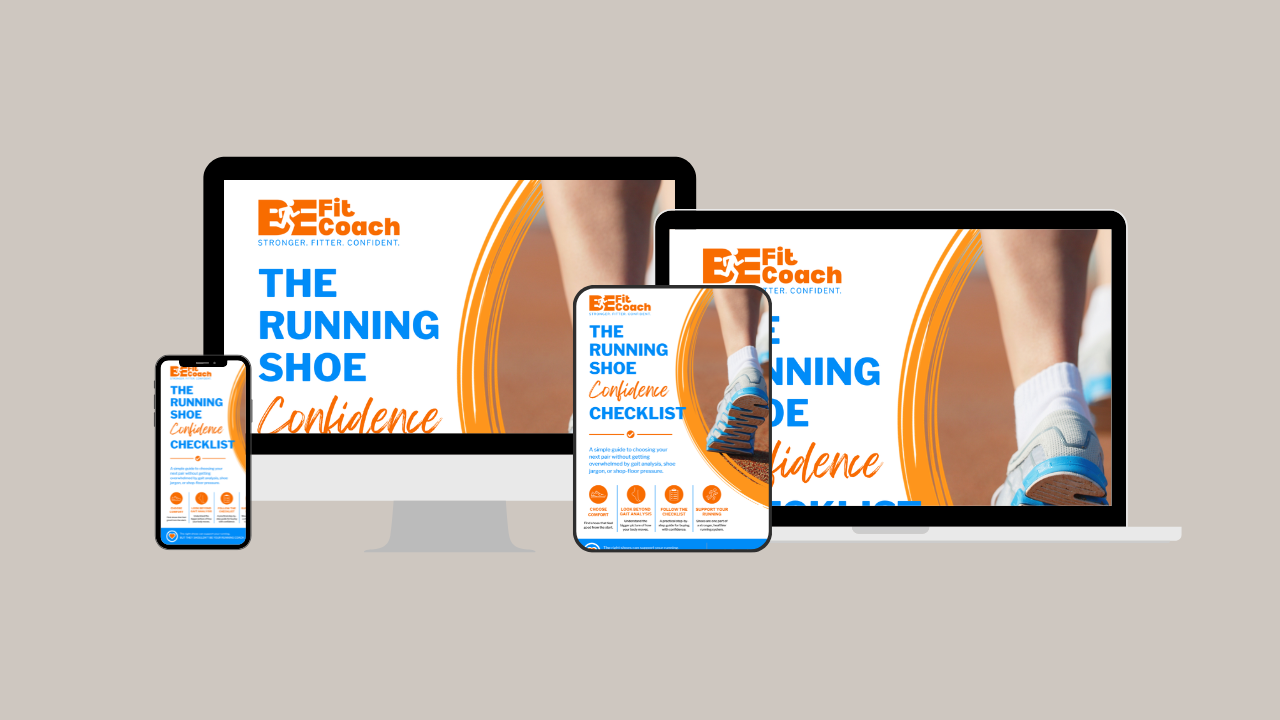
Looking for the quick version? Download The Running Shoe Confidence Checklist here: https://www.be-fit-coach.co.uk/pl/2148800918
The Common Running Shoe Advice
The usual advice for buying running shoes goes something like this:
- Visit a specialist running shop
- Have a gait analysis
- Find out whether you need neutral, stability, support, or motion-control shoes
- Try a few options from that category
- Buy the shoe that appears to correct your movement the best
For a beginner runner, this can feel reassuring.
It gives you a clear answer.
It makes the decision feel more scientific.
It also removes some of the pressure because someone else is telling you what to buy.
And I want to be clear: I am not against running shops, and I am not saying gait analysis is useless.
A good running shop can be helpful. A knowledgeable assistant can help you think about comfort, fit, shoe type, and whether a shoe feels right when you walk or jog in it.
The problem is when runners believe a quick gait analysis is the full answer.
It is not.
At best, it is a snapshot.
It shows how you moved in that moment, in that environment, usually for a very short period of time, often when you are fresh, on a treadmill, and possibly feeling slightly self-conscious.
That can be useful.
But it is not the same as understanding your running technique, your training history, your strength, your mobility, your injury background, or how your body moves when you are tired, running outside, going uphill, going downhill, or building distance over time.
Your Gait Is Not Just A Foot Problem
This is the bit many runners miss.
If your foot rolls in, your knee collapses slightly, your hip drops, or your stride looks inefficient, that does not automatically mean the shoe is the problem.
It may be part of the picture, but it may not be the root cause.
Your running gait can be influenced by:
- How strong your feet, calves, glutes, and hips are
- How mobile your ankles, hips, and spine are
- How well you control movement through your hips, knees, and ankles
- Whether you are overstriding
- How quickly your training load has increased
- Whether you are fatigued
- Whether you are returning from injury
- How confident or tense you feel when running
- How experienced you are as a runner
So when a shoe is used to “correct” a movement pattern, I always want to know what is actually being corrected.
Is the shoe helping the runner feel comfortable and supported?
Or is it masking a movement issue that could be improved with better training, strength, mobility, and technique work?
That is an important distinction.
Is Support Always Bad?
No.
And this is where I want to be balanced.
I am not saying no runner should ever wear a stability shoe or a more supportive shoe.
Some runners feel better in them. Some runners may need more structure at certain times. Some may be managing pain, returning from injury, or following advice from a qualified healthcare professional.
That can be completely valid.
The issue is not the shoe itself.
The issue is when the shoe becomes the whole solution.
If a runner is told they need a certain shoe because of how they move, but nobody looks at why they move that way, something is being missed.
A supportive shoe may help in the short term.
But if the underlying issue is weakness, stiffness, poor control, overstriding, fatigue, or training load progressing too quickly, then the shoe may only be sticking a plaster over the problem.
That is why my approach is not simply:
“Never wear support shoes.”
My approach is:
“Do not rely on shoes to do the job of good training, strength, mobility, recovery, and technique development.”
The Better Question To Ask
Most runners ask:
“What shoe do I need?”
That is a fair question.
But I think a better question is:
“What shoe feels comfortable, fits well, supports the running I am actually doing, and allows me to keep improving how my body moves?”
That shift matters.
Instead of looking for a shoe to fix you, you are looking for a shoe that supports you.
That is a much healthier mindset.
Because your body is not broken.
Your body may simply need better preparation, better progression, better strength, better mobility, or better technique.
The shoe can be part of that system.
But it should not replace the system.
How I Recommend Choosing Running Shoes
When beginner runners ask me how to choose shoes, I usually encourage them to keep things simple.
Start with comfort and fit.
That does not mean comfort is the only thing that matters, but it is one of the best starting points.
When you try shoes on, ask yourself:
- Do they feel comfortable when standing?
- Do they feel comfortable when walking?
- Do they feel comfortable when jogging?
- Do your toes have enough room to move?
- Does your heel feel secure without slipping?
- Is there any rubbing, pinching, numbness, or pressure?
- Do they feel natural, or do they feel like they are forcing your foot into a position?
A good running shoe should feel good from the start.
Do not rely on “breaking them in” if they feel wrong straight away.
Also, avoid choosing shoes based purely on:
- Brand
- Colour
- Trends
- What someone else is wearing
- Sales pressure
- A quick gait analysis alone
The best shoe for you is not always the most technical shoe.
It is the one that feels comfortable, fits well, and supports the running you are actually doing.
Be Careful With Big Shoe Changes
This is especially important.
If you are changing from one type of shoe to another, your body may need time to adapt.
Big shoe changes include:
- Moving from support shoes to neutral shoes
- Moving from high-drop shoes to low-drop shoes
- Moving from cushioned shoes to minimalist shoes
- Moving into carbon-plated shoes
- Moving into a much lighter, firmer, or more flexible shoe
That does not mean you cannot make those changes.
It means you should introduce them gradually.
A different shoe can place different demands on your feet, calves, Achilles, shins, knees, hips, and lower back.
So do not suddenly change shoe type and then use the new pair for long runs or hard sessions straight away.
Start with short, easy runs.
Build up gradually over several weeks.
Pay attention to how your body responds.
If you notice new tightness, discomfort, or recurring niggles, do not ignore it.
Your body is giving you useful feedback.
What About Shoe Mileage?
Running shoes do not last forever.
A common guide is around 300-500 miles for most runners, but this is only a rough range.
How long your shoes last will depend on:
- Your body weight
- Your running style
- The surfaces you run on
- How often you run
- The shoe model
- Whether you rotate between more than one pair
Mileage is useful, but it is not the only thing to watch.
You should also pay attention to how your shoes feel.
Signs your shoes may need replacing include:
- The outsole is worn or flattened
- The midsole feels less cushioned or more “dead”
- You notice new aches, pains, or niggles
- The shoes feel less supportive or stable
- You are lacing them tighter than usual
- The upper is torn, stretched out, or no longer holds your foot well
If in doubt, trust your body.
Discomfort is information.
Where Gait Analysis Fits In
A gait analysis can be useful.
It can show how your foot strikes, how your foot moves, and how your body appears to move at that moment.
But it cannot show everything.
It cannot fully tell you:
- Your strength
- Your mobility
- Your movement control
- Your training load
- Your fatigue levels
- Your recovery habits
- Your running technique over longer distances
- Your injury history
- Your confidence
- Your goals
That is why I would never want a runner to treat gait analysis as the final answer.
Use it.
Learn from it.
Ask questions.
But do not let it make the whole decision for you.
Your full picture is bigger than any snapshot.
The Bigger Picture
At BE Fit Coach, I look at running through the 7 Core Pillars of Running:
- Running Training
- Technique
- Strength
- Mobility
- Rest & Recovery
- Nutrition
- Mindset
Shoes fit into that bigger picture, but they are only one part of it.
A good pair of shoes can support your running.
But if your training is progressing too quickly, your calves are overloaded, your hips are weak, your mobility is limited, or your technique is inefficient, the shoe alone is unlikely to solve everything.
That is actually good news.
Because it means you are not stuck waiting for the perfect pair of shoes before you can improve.
You can build strength.
You can improve mobility.
You can develop better technique.
You can manage your training load more intelligently.
You can learn to listen to your body.
And over time, you can become a stronger, more confident runner.
Download The Free Running Shoe Confidence Checklist
If you’re thinking about buying new running shoes, don’t rely on guesswork, jargon, or shop-floor pressure.
I’ve created a free checklist to help you:
-
Know what to check before you buy
-
Understand what to look for when trying shoes on
-
Spot the red flags that suggest a shoe is not right for you
-
Use gait analysis as useful information, not the whole decision
-
Avoid making big shoe changes too quickly
Download The Running Shoe Confidence Checklist here:
https://www.be-fit-coach.co.uk/pl/2148800918
Final Thought
Your shoes matter.
But they are not the whole story.
The right shoes can support your running, improve comfort, and help you feel more confident.
But they should not replace good training, strength work, mobility, recovery, technique development, or listening to your body.
A running shoe can support your running.
But it should not be your running coach.
If you are part of the BE Fit Coach running group and you are unsure about your current shoes, bring them along to your next group run and I will happily have a quick look.
And if you want a clearer picture of how your body moves when you run, a running technique assessment can help you look beyond the shoes and understand the bigger picture.
7 Core Pillars™ Guide for Runners - Free Mini-Guide & Checklist
Download the 7 Core Pillars™ Guide for Runners to build your running the right way - base, quality, technique, recovery and more. Simple, actionable, and proven with real runners.
We will only send you occasional information that we believe will be of interest to you (and you can unsubscribe at any time).