
Your calories are on target.
Protein: nailed it.
Carbohydrate: exactly where you wanted it.
Fat: within a couple of grams.
So that means your diet is good… right?
Not necessarily.
Tracking calories and macronutrients can be genuinely useful. I use it with clients when it gives us information that helps us make better decisions.
But problems start when those numbers become the entire definition of a good diet.
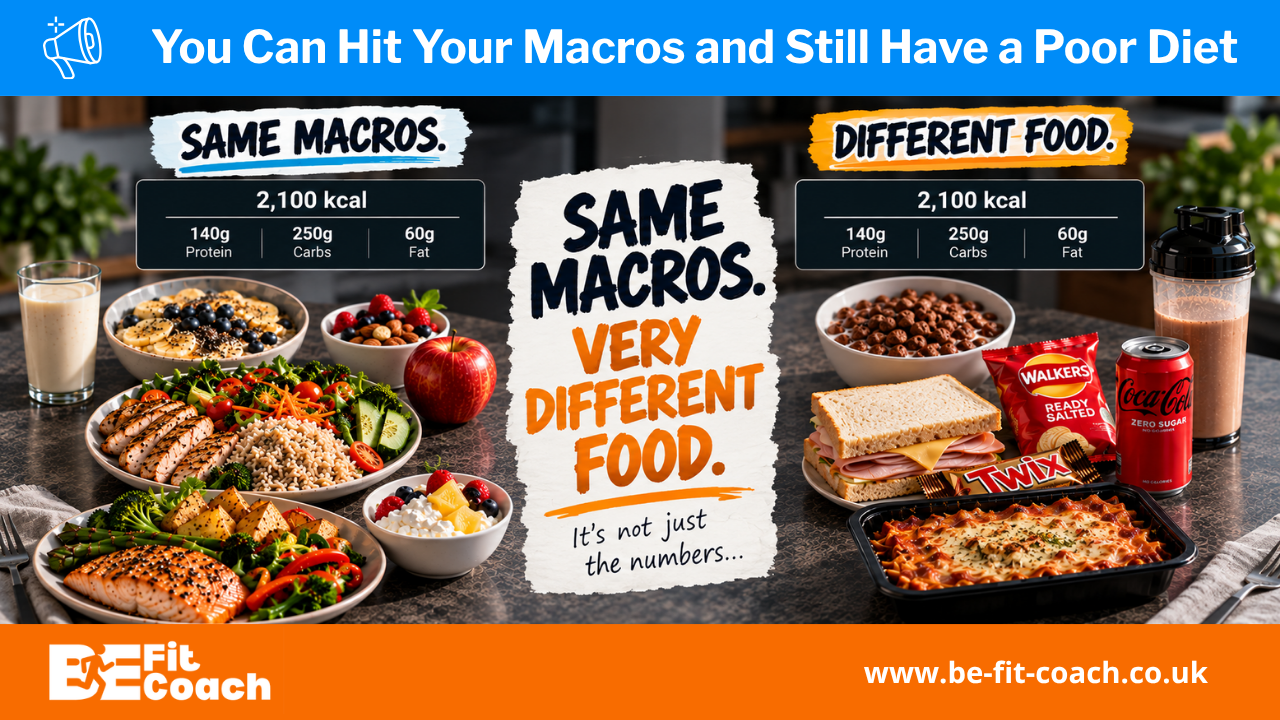
Two people can finish the day with almost identical calories, protein, carbohydrate and fat while eating very differently.
One might have eaten a varied diet containing fruit, vegetables, wholegrains, potatoes, beans, nuts, dairy, meat or other protein sources.
The other might have constructed most of their intake from protein bars, shakes, ready meals, sweets and whatever foods made the numbers fit.
Both apps could show four green ticks.
That does not make the diets nutritionally identical.
Macros answer a useful but limited question
Your macronutrients are:
-
Protein
-
Carbohydrate
-
Fat
Along with alcohol, they provide the energy in your diet.
Knowing roughly how much you are eating can therefore be very useful.
Calories matter when we are trying to understand energy intake and body-weight change.
Protein matters for things such as muscle repair, adaptation and maintaining lean tissue.
Carbohydrate is particularly relevant to runners because it helps support training and higher-intensity performance.
Fat is an essential part of the diet too.
None of that becomes untrue simply because we start talking about diet quality.
The mistake is assuming that once those numbers are correct, everything else must also be correct.
It isn't.
Your app doesn't know what your carbohydrate came from
Imagine two runners both eating 300g of carbohydrate.
One gets much of it from foods such as oats, potatoes, rice, wholegrain bread, fruit, vegetables and pulses.
The other gets most of it from sweets, sugary drinks, biscuits and highly refined convenience foods.
The carbohydrate total might be identical.
The diets aren't.
The first pattern is likely to provide considerably more fibre and a broader range of vitamins, minerals and other components of food.
The same thing can happen with fat. Two people might both eat 70g per day, while the balance of saturated and unsaturated fats is very different.
Or protein. A protein target tells us how much protein somebody ate. It doesn't tell us whether the rest of their diet has enough iron, calcium, fruit, vegetables, fibre or variety.
Macros describe part of the diet.
They don't describe the whole thing.
So what does diet quality add?
Instead of asking only:
Did I hit my numbers?
We also ask:
What foods regularly produced those numbers?
That opens up some useful questions.
Are you eating a reasonable variety of foods?
Are fruit and vegetables appearing regularly?
Are you getting enough fibre?
Where is your dietary fat coming from?
Are restrictive food choices creating obvious gaps?
Are convenience foods helping your diet work around a busy life, or gradually replacing most of the foods that would normally provide greater nutritional variety?
Those questions tell us things that the protein, carbohydrate and fat totals cannot.
Fibre is a good example
UK guidance recommends adults aim for around 30g of fibre per day.
Yet it is perfectly possible to hit a calorie and macro target while eating considerably less than that.
Fibre matters for digestive health, and higher-fibre dietary patterns are associated with lower risk of cardiovascular disease, type 2 diabetes and bowel cancer.
But if the only number you are watching is carbohydrate, 30g of carbohydrate from one food can look much the same as 30g from another.
Your body doesn't necessarily receive the same package.
That doesn't mean every carbohydrate you eat needs to be wholegrain or high-fibre.
Sometimes lower-fibre carbohydrate is exactly what a runner wants.
Before a race, during long-duration exercise or close to a demanding session, easily digested carbohydrate can be extremely useful.
Context matters.
The point is that one number cannot tell you whether the overall pattern is working.
Micronutrients barely appear in your macro totals
Vitamins and minerals have important roles in normal health and, in some circumstances, training and performance.
A runner can eat “perfect macros” while still having a dietary pattern that creates a greater risk of inadequate intake of particular nutrients.
That does not mean everyone needs to start micromanaging twenty different micronutrient targets.
And it doesn't mean you should diagnose deficiencies from a food-tracking app.
It simply means food choice and variety still matter.
If your diet becomes very restricted because everything is being chosen according to how neatly it fits your macros, it is worth looking beyond the numbers.
Runners aren't automatically good eaters
Being active does not give us a free pass.
Research looking specifically at diet quality in adult athletes still finds plenty of room for improvement.
You can train six days a week and still eat very few vegetables.
You can run marathons and still rely heavily on convenience foods.
Fitness and diet quality are not the same thing.
Sport can also encourage us to judge food mostly by what it does for training:
“How many carbs?”
“How much protein?”
“Will this fuel tomorrow's run?”
Those are useful questions.
They just aren't the only useful questions.
Does this mean processed food is bad?
No.
Saying macros don't tell us everything does not mean the alternative is to eat only “clean”, unprocessed food.
Processed foods can be extremely useful.
Bread is processed.
Tinned beans are processed.
Breakfast cereal is processed.
A protein shake can be a convenient way of helping somebody reach their protein requirements.
A gel is a deliberately engineered source of carbohydrate, and that can make it extremely useful during prolonged running.
Ready meals can help somebody eat adequately when time is short.
Food needs to work in the life of the person eating it.
There is also growing research around diets high in ultra-processed foods.
Large observational studies consistently associate higher ultra-processed-food intake with poorer health outcomes, but association alone cannot tell us that processing itself is responsible for every one of those outcomes.
Controlled feeding studies add useful context.
In one well-known trial, people ate more calories and gained more weight when given an ultra-processed diet than when given a minimally processed diet, despite the diets being designed to be similar in several nutritional characteristics.
A more recent UK trial compared minimally processed and ultra-processed diets that both followed the principles of the Eatwell Guide. Participants lost weight on both, but lost more on the minimally processed diet.
Interesting?
Absolutely.
Proof that every ultra-processed food is unhealthy?
No.
For most people, a better question is:
What is this food contributing, and what is it replacing?
You don't need a perfect diet
This article isn't a request to make eating more complicated.
You shouldn't need a spreadsheet containing forty nutritional targets before you are allowed to eat dinner.
Nor does every meal need to be nutritionally perfect.
The UK Eatwell Guide is based on the overall pattern of eating across a day or even a week, not achieving perfect proportions at every meal.
That gives us quite a lot of flexibility.
A meal can be chosen because it is convenient.
Some food can simply be there because you enjoy it.
Your pre-run food might deliberately be lower in fibre.
A protein shake might be easier than cooking.
You might eat cake at a birthday party without first checking whether it fits an ideal nutrient-density score.
Look at the pattern, not one food.
Look one layer deeper than your macros
If you already track calories and macros, you don't necessarily need to stop.
Instead, use the information better.
This follows the same principle I discussed in Tracking Isn't the Goal – Awareness Is.
Once you know roughly what your calorie and macro intake looks like, go one layer deeper.
1. Are the targets appropriate in the first place?
Before worrying about diet quality, make sure the target itself makes sense.
Enough protein is useful.
Enough carbohydrate matters if you are training regularly.
And constantly trying to force calories lower is not automatically healthier.
A varied diet still cannot compensate for consistently eating too little to support your training and recovery.
2. Where is your fibre coming from?
Look across a normal week.
Fruit?
Vegetables?
Wholegrains?
Potatoes with the skin?
Beans and pulses?
Nuts and seeds?
You don't need all of them every day.
But if the answer is “hardly any of them”, your perfect carbohydrate target isn't telling the whole story.
3. How repetitive is your diet?
Consistency is useful.
Eating the same breakfast because it works for you is not a problem.
But if almost everything you eat comes from the same handful of foods, ask whether convenience has gradually turned into unnecessary restriction.
Variety makes it easier to obtain a wider spread of nutrients without micromanaging every vitamin and mineral individually.
4. Look at what makes up your fat intake
Don't stop at:
Fat target: 70g.
Look at where it regularly comes from.
Foods such as nuts, seeds, olive or rapeseed oil and oily fish can provide unsaturated fats alongside other nutrients.
That doesn't mean saturated fat must disappear.
Again, this is about the overall pattern.
5. Check whether convenience foods are helping or crowding things out
A protein bar because you are driving between appointments?
Useful.
A ready meal because you've finished work late?
Fine.
Sports drink during a long race?
Possibly exactly what you need.
But if convenience foods now make up nearly every meal because they are easy to track and always fit the numbers, that's worth noticing.
The goal is not to remove them.
It is to make sure they aren't replacing almost everything else.
What your tracker can and can't tell you
Tracking should help you learn.
If your protein is always low at breakfast, that's useful information.
If you continually struggle to eat enough carbohydrate around your harder running, that's useful.
If calories are much higher than you realised, that may be useful too.
But a macro tracker can tell you:
2,100 calories.
140g protein.
250g carbohydrate.
60g fat.
It cannot look at those four numbers and tell you:
Yes, that's a good diet.
There simply isn't enough information.
Coach's Decision
If your calories and macros are where they need to be, don't throw them away. Look one layer deeper.
Ask what foods are repeatedly providing those numbers.
If you are getting enough fibre, a reasonable spread of fruit, vegetables and other nutrient-dense foods, varied sources of protein, carbohydrate and fat, and the diet works around your training and normal life, your macro targets are probably doing a useful job.
If the numbers are perfect but most meals are built around the same limited convenience foods and obvious gaps remain, don't chase even tighter macro precision.
Improve the food pattern behind the numbers.
7 Core Pillars™ Guide for Runners - Free Mini-Guide & Checklist
Download the 7 Core Pillars™ Guide for Runners to build your running the right way - base, quality, technique, recovery and more. Simple, actionable, and proven with real runners.
We will only send you occasional information that we believe will be of interest to you (and you can unsubscribe at any time).