
We can track almost anything now.
Calories. Protein. Body weight. Steps. Pace. Heart rate. Sleep. Training load. Recovery scores.
And tracking can be genuinely useful.
I use it in coaching. I use it myself. There are plenty of situations where having an objective number gives us information we simply would not have otherwise.
But there is a difference between collecting a number and learning something from it.
You can log every calorie you eat without getting much better at understanding your eating habits.
You can weigh yourself every morning and still react emotionally to every individual reading.
You can record every run without learning how pace, effort and fatigue relate to one another.
And you can own a watch that measures almost everything your body does while still being unsure what to do when one of those numbers changes.
The problem isn't tracking.
The problem is when hitting, recording or improving the number becomes the goal instead of using the number to make a better decision.
A useful question is:
What did this number help me notice?
That is where tracking starts to become useful.
Tracking works best when something happens next
There is good evidence that self-monitoring can help people change behaviour.
It appears regularly in successful behaviour-change interventions involving physical activity, eating and weight management. Reviews of self-regulation research have found useful effects from techniques including self-monitoring, goal setting and feedback, although they do not work equally well for every behaviour or every person.
That last part matters.
The mechanism isn't simply:
Record something → improve.
A better way to think about it is:
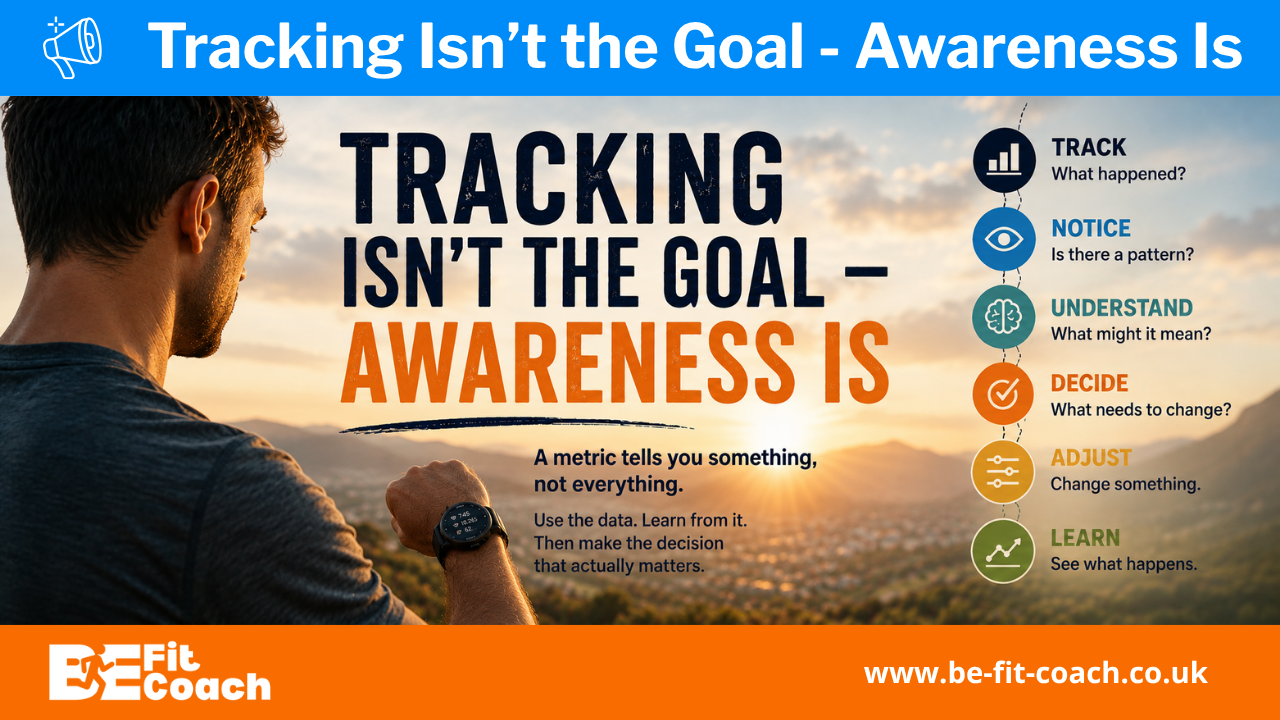
Track → Notice → Understand → Decide → Adjust → Learn
You collect the data.
You notice a pattern.
You try to understand why it might be happening.
You decide whether anything needs changing.
You make an adjustment.
Then you see what happens.
That is self-monitoring being used as part of self-regulation.
The tracking gives you something to work with. It doesn't do the thinking for you.
Data isn't the same as understanding
Imagine I tell you that you averaged 7,346 steps per day last week.
That's data.
If I then tell you that your normal average is around 10,000 and most of the reduction happened on the three days you worked from home, we have added some context.
Now the number is becoming information.
If we realise that travelling to work normally creates several short walks throughout the day that disappear when you work from home, we have started to understand what is happening.
Only then do we have a useful decision to make.
Perhaps nothing needs changing.
Perhaps adding a short lunchtime walk on home-working days would help.
The important bit is that 7,346 wasn't the decision.
It helped us reach one.
That distinction applies to plenty of the numbers we use in health and fitness:
Data → Information → Understanding → Decision
Tracking only guarantees the first step.
Calories: did you hit the target, or did you learn something?
Calorie tracking is probably one of the clearest examples.
Digital dietary self-monitoring can be useful in behavioural weight-management interventions. One meta-analysis found that digital monitoring of diet and physical activity supported weight loss, increased moderate physical activity and reduced calorie intake compared with control conditions.
So this isn't an argument that calorie tracking doesn't work.
But imagine your target is 2,000 calories.
You finish the day at 1,997.
Success?
Possibly.
But there are more useful questions.
Was hitting 2,000 relatively easy today?
Were you starving by the evening?
Did most of your calories arrive after 7pm because you barely ate during the day?
Are weekends consistently much harder than weekdays?
Are there particular meals that keep you satisfied for longer?
Does a busy afternoon lead to grazing later?
Those observations can eventually make eating well easier.
The calorie total helped reveal them.
If the only lesson you take from months of tracking is that 1,997 is good and 2,143 is bad, you may have become very accurate at recording food without becoming much better at understanding it.
And that matters because detailed dietary tracking can be demanding. Reviews consistently find that adherence tends to decline over time, particularly when recording requires substantial effort. Lower-intensity monitoring approaches can sometimes still be useful, although the evidence doesn't give us one perfect level of tracking that works for everybody.
So there is no prize for collecting more detail than you actually need.
Body weight: one measurement or a pattern?
Body weight creates a slightly different problem.
A scale gives you an objective measurement, but body weight naturally moves around from day to day.
Food in the digestive system, carbohydrate storage, associated water, fluid intake and losses, and other short-term factors can all change the reading without representing an equivalent change in body fat.
That doesn't make today's weight useless.
It means today's weight needs context.
Research on self-weighing is another good example of why the monitoring itself shouldn't be confused with the whole intervention.
Regular weighing has often been associated with better weight-management outcomes, particularly when it forms part of a broader behavioural approach. But trials looking at self-weighing alone have been less convincing, and research has not consistently shown that simply demanding more frequent weighing automatically produces better results.
The useful question therefore isn't always:
“What did I weigh this morning?”
It might be:
“What is the trend doing?”
If your weight has moved up and down all week but the longer-term trend is still heading in the intended direction, that tells a very different story from treating each morning as a new verdict.
At the same time, there are situations where one measurement does matter. A sudden or unusual change may sometimes deserve attention.
The answer isn't to ignore individual readings.
It's to interpret them appropriately.
Your running watch can give you information. It can't decide what the run meant.
Running gives us another version of the same problem.
You planned an easy run.
Your normal easy pace might be around 10:00 per mile.
Today you're running 10:30.
Is that bad?
Not necessarily.
Perhaps it is hot.
Perhaps the route is hillier.
Perhaps you trained hard yesterday.
Perhaps your heart rate and perceived effort are exactly where you wanted them.
Or perhaps the slower pace is part of a repeated pattern alongside unusually high effort and poor recovery.
The pace itself doesn't answer those questions.
It gives us something to investigate.
This is why I don't like turning ordinary training into a constant test that has to be passed.
Pace, heart rate and other running metrics can be very useful. They help us understand workload, effort, progression and how someone responds to training.
But if every run becomes good or bad depending on whether the watch shows the expected number, the measurement has stopped helping us understand the training and started dictating how we feel about it.
More data doesn't automatically mean better decisions
Wearables make this particularly easy to see.
Modern watches can collect enormous amounts of data with virtually no effort from us.
Steps.
Heart rate.
Sleep.
Heart-rate variability.
Training load.
Recovery scores.
Readiness.
Stress.
The fact that the watch can measure something does not automatically mean you need to make a decision about it.
Wearable activity trackers can genuinely change behaviour. Large reviews suggest they can produce modest increases in physical activity, including more daily steps and moderate-to-vigorous activity.
But those same reviews also show variation between people, populations and intervention designs.
In other words, wearing the device isn't magic.
The useful part is what happens because of the information.
If your watch helps you notice that your activity drops dramatically on certain days and you choose to change something, great.
If six months of sleep scores have helped you recognise that late nights consistently affect how you feel and train the next day, useful.
If you wake up feeling fine, see an unexpected recovery score and immediately change your training simply because the algorithm has told you to, that is a different relationship with the data.
The number has started making the decision.
That doesn't mean the score should be ignored.
It means it should be considered alongside the rest of the information you have.
Tracking doesn't have to be temporary
There is sometimes a temptation to turn this argument into:
“Track for a while, learn what you need, then stop.”
That can be appropriate.
It isn't a rule.
Some people genuinely find long-term tracking useful.
Logging food may provide useful accountability.
Regular weighing may identify gradual drift before it becomes substantial.
Training records allow you to compare what you are doing now with what you did months or years ago.
Step counts can stop a sedentary week quietly becoming normal.
Those are perfectly sensible reasons to continue.
The goal isn't necessarily to remove the tool.
It's to become better at using it.
Ideally, the longer you track something, the more you understand what the numbers mean in your own context.
You become less likely to panic about meaningless variation.
You get better at recognising patterns.
You know which numbers genuinely affect your decisions and which ones are mostly noise.
And you become less dependent on somebody—or an algorithm—interpreting every number for you.
A simple way to make tracking more useful
The next time you look at something you track, don't stop with:
“Did I hit the number?”
Try this instead:
1. Track
What actually happened?
2. Notice
Is there a pattern worth paying attention to?
3. Understand
What might explain it?
4. Decide
Does anything actually need to change?
5. Adjust
If it does, change something specific.
6. Learn
Did that change have the effect you expected?
Then repeat the process if necessary.
Not every number requires an adjustment.
Sometimes tracking confirms that everything is going fine.
That's useful too.
The metric tells you something, not everything
This is the principle I keep coming back to.
A calorie target tells us something about energy intake.
It doesn't tell us everything about diet quality.
A protein target tells us something about protein intake.
It doesn't tell us everything about how somebody eats.
Body weight tells us something about body mass.
Pace tells us something about speed.
A recovery score tells us something about the data and algorithm used to produce it.
Each can be useful.
Problems start when we ask a metric to answer a question it was never designed to answer.
That is why one of the next subjects I want to explore is how someone can hit their calorie and macronutrient targets while still having plenty of room to improve the overall quality of their diet.
The numbers are useful.
They just aren't the whole picture.
Coach’s Decision
Don't ask only whether you hit the number. Ask what the number helped you learn.
If tracking is helping you spot useful patterns and make better decisions, it is doing its job.
If you are recording more and more data but learning nothing from it—or changing your behaviour mainly to satisfy the metric—the tracking has started to become the goal.
You don't necessarily need to stop tracking.
Use the data. Learn from it. Then make the decision that actually matters.
7 Core Pillars™ Guide for Runners - Free Mini-Guide & Checklist
Download the 7 Core Pillars™ Guide for Runners to build your running the right way - base, quality, technique, recovery and more. Simple, actionable, and proven with real runners.
We will only send you occasional information that we believe will be of interest to you (and you can unsubscribe at any time).