

Have you ever been out for a run and thought:
“My legs feel like they could keep going, but my breathing is the thing stopping me”?
If so, you are definitely not on your own.
This is one of the most common things I hear from beginner runners, returning runners, and even more experienced runners who are coming back after a break.
The legs feel okay.
The body feels like it has more to give.
But the breathing starts to feel rushed, uncomfortable, or even slightly panicky.
And once that happens, the brain usually joins in too:
“This is too hard.”
“I’m struggling.”
“I need to stop.”
Before long, it can feel like your breathing is controlling the whole run.
But here’s the important thing to understand:
Getting out of breath does not mean you are failing.
It does not mean you are bad at running.
And it does not mean you are not built for it.
It usually means your body is giving you feedback.
And once you understand that feedback, you can start doing something useful with it.
Your Breathing Is Feedback, Not Failure
When your breathing feels difficult during a run, it is usually a sign that the current effort level is slightly higher than your body can comfortably sustain at that moment.
That does not mean you are unfit.
It does not mean you cannot do it.
It simply means your aerobic system, pacing, breathing rhythm and confidence are still developing.
A lot of runners make the mistake of thinking they need to push harder when breathing becomes difficult.
But often, the smarter option is to take a little pressure off.
That might mean slowing the pace slightly.
It might mean relaxing your shoulders and upper body.
It might mean focusing on a steadier out-breath.
Or it might mean using a short walk break before things feel completely out of control.
None of that is failure.
That is good pacing.
That is learning how to manage your effort.
And that is exactly how you become a stronger, more confident runner over time.
You Either Control Your Breathing, Or Your Breathing Starts To Control You
One thing I often say to runners is this:
"You either control your breathing, or your breathing starts to control you."
That might sound simple, but it is a really important point.
When your breathing becomes fast, shallow or panicky, it does not just affect your body. It affects your brain too.
Your brain starts to receive the message:
“I’m breathing really fast, so I must be struggling.”
And because your brain’s job is to protect you, it may start reinforcing that message:
“This is hard.”
“You are struggling.”
“You should probably stop now.”
That does not mean your body is actually done.
It may simply mean your breathing has become the loudest signal.
But when you keep some conscious control over your breathing, you send a different message back to your brain.
Instead of:
“I’m struggling.”
You start to create the feeling of:
“I’ve got this.”
“I’m in control.”
“I can keep going.”
This is why breathing is not just a physical part of running. It is also a confidence tool.
You are not trying to breathe perfectly.
You are trying to stay calm enough that your breathing does not take over.
The Legs, Lungs And Mind Model
Most runners tend to struggle in one of three areas at different points in their running journey:
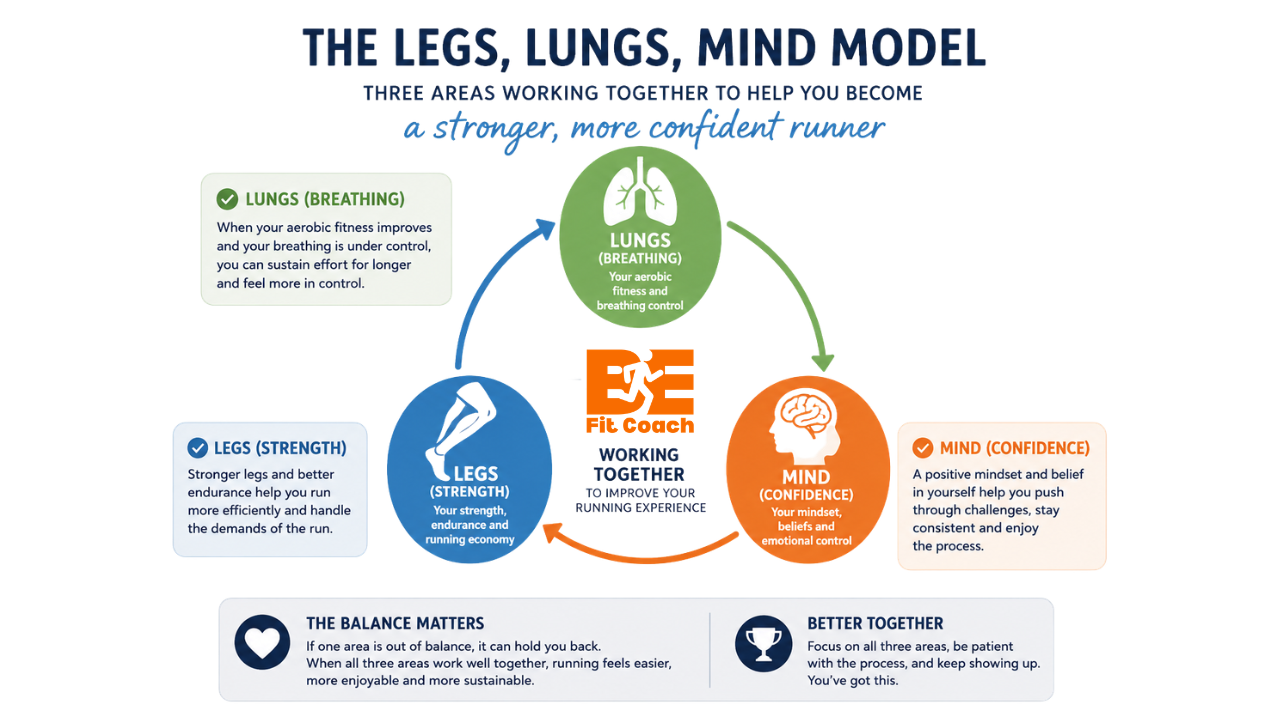
Sometimes your legs are the thing that struggle most.
They might feel heavy, tired, weak, sore, or full of that burning feeling that makes every step feel harder.
Sometimes your breathing is the thing that struggles most.
You might feel out of breath, unable to settle into a rhythm, or like your lungs are working harder than your legs.
And sometimes the mind is the biggest challenge.
You start doubting yourself, questioning whether you can keep going, or feeling like you need to stop even when your body may still have more to give.
The important thing is that these areas can change.
At one stage of your running journey, your legs might be the limiter.
At another stage, it might be your breathing.
At another stage, it might be your confidence or mindset.
That does not mean anything has gone wrong.
It just tells you what needs attention next.
If Your Legs Feel Fine But Your Breathing Feels Hard
If your legs feel strong enough to keep going but your breathing is stopping you, that is actually useful information.
It suggests that your body has enough strength to cope with the session, but your breathing rhythm and aerobic fitness still need time to catch up.
That is very common.
Especially if you are newer to running, returning after time away, or running at a pace that is slightly too quick for your current fitness level.
The aim is not to force your way through every run.
The aim is to learn how to manage your breathing before it takes over.
Here are a few simple things that can help.
Start Easier Than You Think You Need To
Most runners start too fast.
Not always by a lot.
But enough that the breathing starts to climb earlier than it needs to.
The problem is that once your breathing feels rushed, it can be hard to get it back under control without slowing down or stopping.
So one of the best things you can do is start easier than you think you need to.
Let your body settle.
Let your breathing find a rhythm.
Give yourself time to feel in control before asking for more effort.
A good run does not need to feel hard from the first minute.
In fact, for most runners, it probably should not.
Slow Down Before You Feel Desperate
A lot of runners wait until their breathing feels completely out of control before they do anything about it.
By that point, stopping can feel like the only option.
Instead, try to notice the earlier signs.
Your breathing starts getting shorter.
Your shoulders begin to tense.
Your jaw tightens.
Your thoughts become more negative.
You start thinking, “I can’t keep this up.”
That is the moment to ease back slightly.
Not because you have failed.
But because you are taking control.
Sometimes you do not need to stop.
Sometimes you simply need to reduce the pressure enough for your breathing to settle again.
That is a skill.
And like every other running skill, it improves with practice.
Focus On The Out-Breath
When runners feel out of breath, the natural instinct is often to try and suck more air in.
But it can be just as useful, and sometimes more useful, to focus on the out-breath.
A calm, steady exhale can help you feel more in control.
It can reduce that panicky feeling.
And it gives your breathing a rhythm to follow.
Try not to force it too aggressively.
Just think:
Steady out.
Relax.
Settle.
Then let the next breath come in naturally.
Use A Simple Breathing Rhythm
You do not need to obsess over perfect breathing patterns.
But a simple rhythm can help.
At an easier pace, you might try breathing in for three steps and out for three steps.
As the effort gets harder, you may naturally move towards breathing in for two steps and out for two steps.
The exact pattern matters less than the feeling of control.
The goal is not to count every breath for the whole run.
The goal is to give your breathing something calm and steady to anchor to.
If counting steps helps, use it.
If it makes you overthink, keep it simpler:
Smooth in.
Steady out.
Relaxed body.
Controlled effort.
Relax Your Upper Body
Breathing is harder when the body is tense.
A lot of runners do not realise how much tension they carry in their shoulders, hands, jaw, neck and face.
When those areas tighten, running feels harder than it needs to.
So if your breathing starts to feel uncomfortable, check in with your body.
Are your shoulders creeping up?
Are your hands clenched?
Is your jaw tight?
Are you holding tension in your face?
Try to soften everything.
Drop the shoulders.
Loosen the hands.
Relax the jaw.
Let the arms swing naturally.
Sometimes a small release of tension can make the whole run feel more manageable.
Use Walk Breaks As A Tool, Not A Failure
Walk breaks are often misunderstood.
A lot of runners see them as a sign that they are not good enough.
But used properly, walk breaks are a pacing tool.
They help you stay in control.
They allow the breathing to settle.
They stop the effort from becoming too overwhelming.
And over time, as your fitness improves, those walk breaks usually become shorter, less frequent, or no longer needed in the same way.
The key is to use them early enough.
If you wait until you are completely exhausted, the walk break becomes a rescue.
But if you use it before things spiral, it becomes a strategy.
That is a very different thing.
Your Lungs May Just Need Time To Catch Up
If your legs feel like they can keep going, that is a positive sign.
It means there is strength there.
It means your body is capable of more.
It may simply be that your lungs, aerobic system and breathing confidence need more time to catch up.
This is especially common in the early stages of running.
Your muscles may adapt in one way.
Your breathing may adapt in another.
Your confidence may adapt at a different speed again.
That is normal.
Running fitness is not one single thing.
It is a combination of your muscles, heart, lungs, nervous system, technique, pacing and mindset all learning to work together.
That takes time.
And it takes consistency.
When To Be Sensible
It is normal to feel out of breath when running, especially when you are building fitness or working harder than usual.
But there are times when you should be more cautious.
If you experience chest pain, dizziness, faintness, wheezing, unusual tightness, or breathlessness that feels extreme or worrying, it is sensible to seek medical advice.
The advice in this post is for normal running breathlessness, not symptoms that feel unusual, severe, or unsafe.
The Main Takeaway
If you get out of breath when running, it does not mean you are failing.
It means your body is learning.
Your breathing is giving you feedback about effort, pacing, fitness, tension and confidence.
The aim is not to never feel out of breath.
The aim is to feel more in control when running feels challenging.
Start easier.
Relax your body.
Focus on a steady out-breath.
Use rhythm where it helps.
Take pressure off before things spiral.
And remember:
You either control your breathing, or your breathing starts to control you.
With practice, your breathing becomes less of a barrier.
Your confidence grows.
And the runs that once felt impossible start to feel much more manageable.
Want To Feel More In Control When You Run?
If breathing is one of the things holding you back, this is exactly the kind of thing we work on inside the BE Fit Coach Running Group.
You do not need to be fast.
You do not need to be confident.
And you do not need to have it all figured out before you come along.
You just need a supportive environment where you can learn how to pace yourself, build fitness gradually, and feel more in control when you run.
Join us at Taff Bargoed Park every Tuesday and Thursday at 6:00pm.
👉🏼 Book your free first session here
Final Thought
Getting out of breath when you run does not mean you are failing.
It means your body is learning.
The goal is not to avoid hard breathing completely. The goal is to understand it, manage it, and stay calm enough that it does not take over the whole run.
Start easier. Relax your body. Control the out-breath. Give your lungs time to catch up.
And remember:
You either control your breathing, or your breathing starts to control you.
7 Core Pillars™ Guide for Runners - Free Mini-Guide & Checklist
Download the 7 Core Pillars™ Guide for Runners to build your running the right way - base, quality, technique, recovery and more. Simple, actionable, and proven with real runners.
We will only send you occasional information that we believe will be of interest to you (and you can unsubscribe at any time).